Ownership is implied
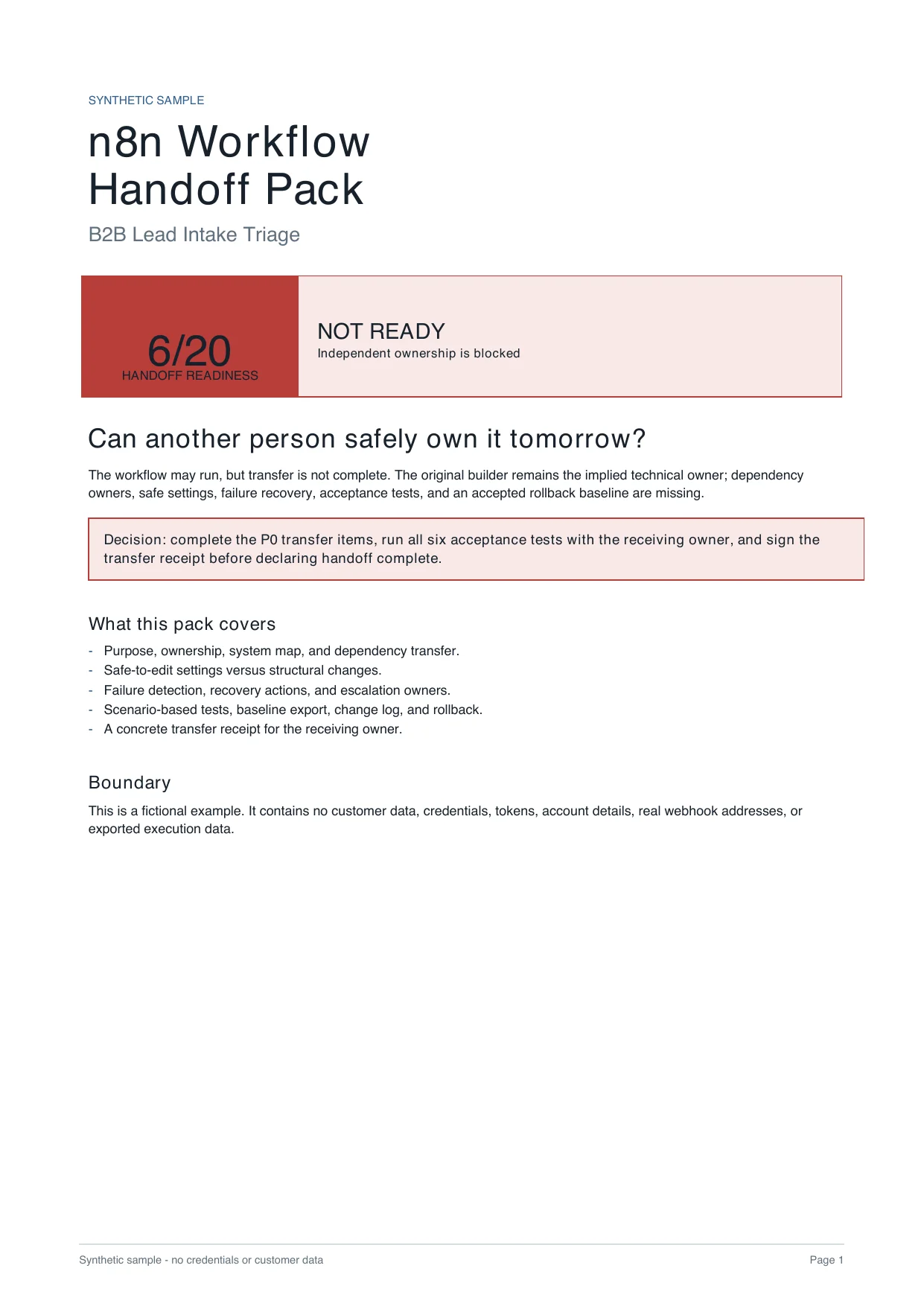
The original builder remains the default incident responder because business, technical, credential, and change owners were never named.
One workflow. Fixed scope. Independent ownership.
Make one live n8n workflow safe for a client or teammate to operate, change, test, and recover without depending on the original builder.
Read-only review. Sanitized materials. No credentials required.
The transfer problem
A successful execution proves the happy path. It does not prove that a new owner knows what they may change, who owns each dependency, what to do when it fails, or how to restore the last accepted version.
The original builder remains the default incident responder because business, technical, credential, and change owners were never named.
Client-editable settings sit beside structural logic, with no clear boundary between routine configuration and breaking changes.
Tests cover the demo, not duplicates, expired credentials, API failures, manual queues, escalation, or rollback.
Best fit
See the deliverable
The sample uses a fictional lead-intake workflow and contains no customer data, credentials, tokens, or real execution records.
Open the full six-page PDFWhat you receive
Can the receiving owner operate, change, test, and recover this workflow without depending on the original builder?
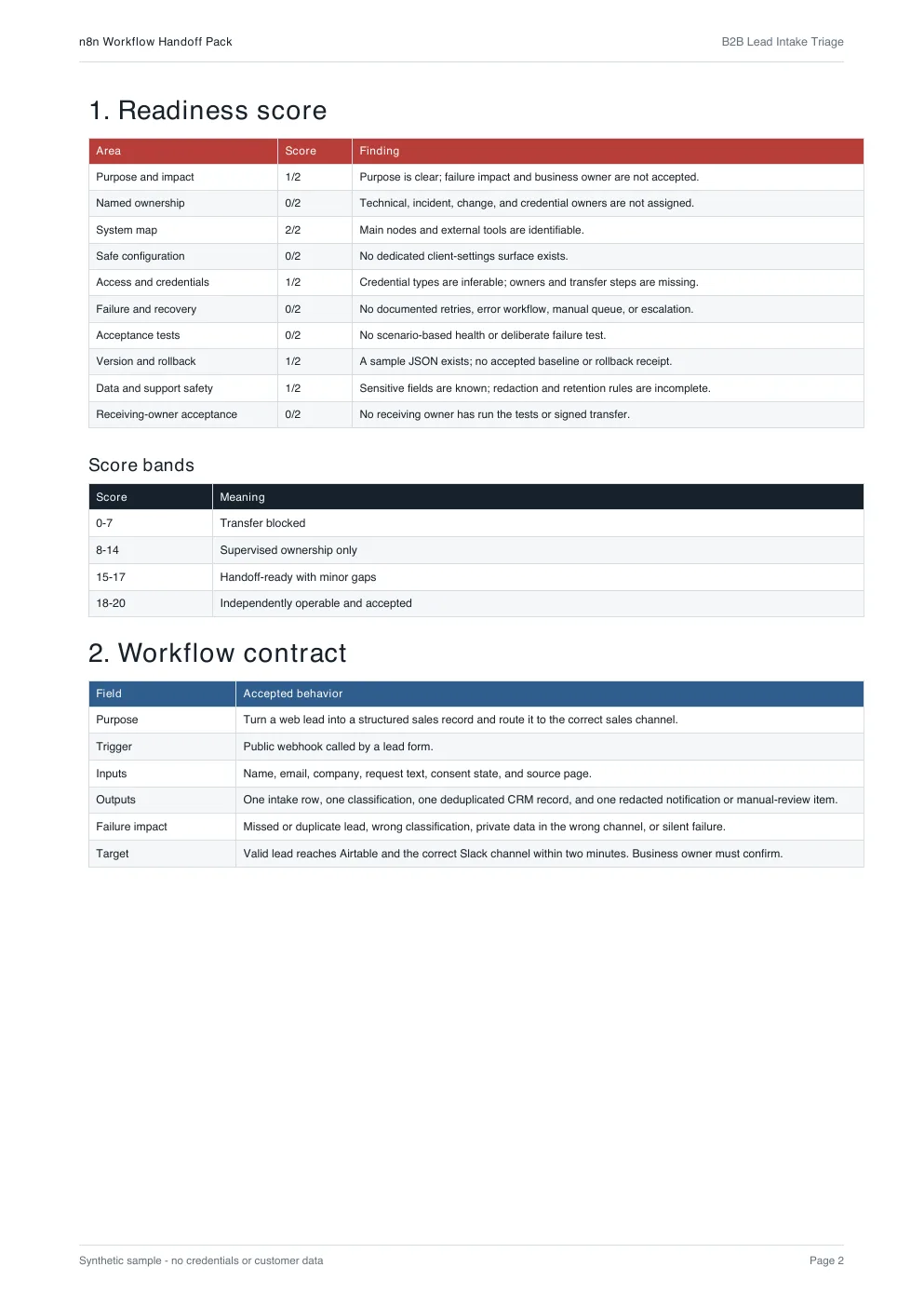
Ten operating areas scored with blockers and accepted gaps.
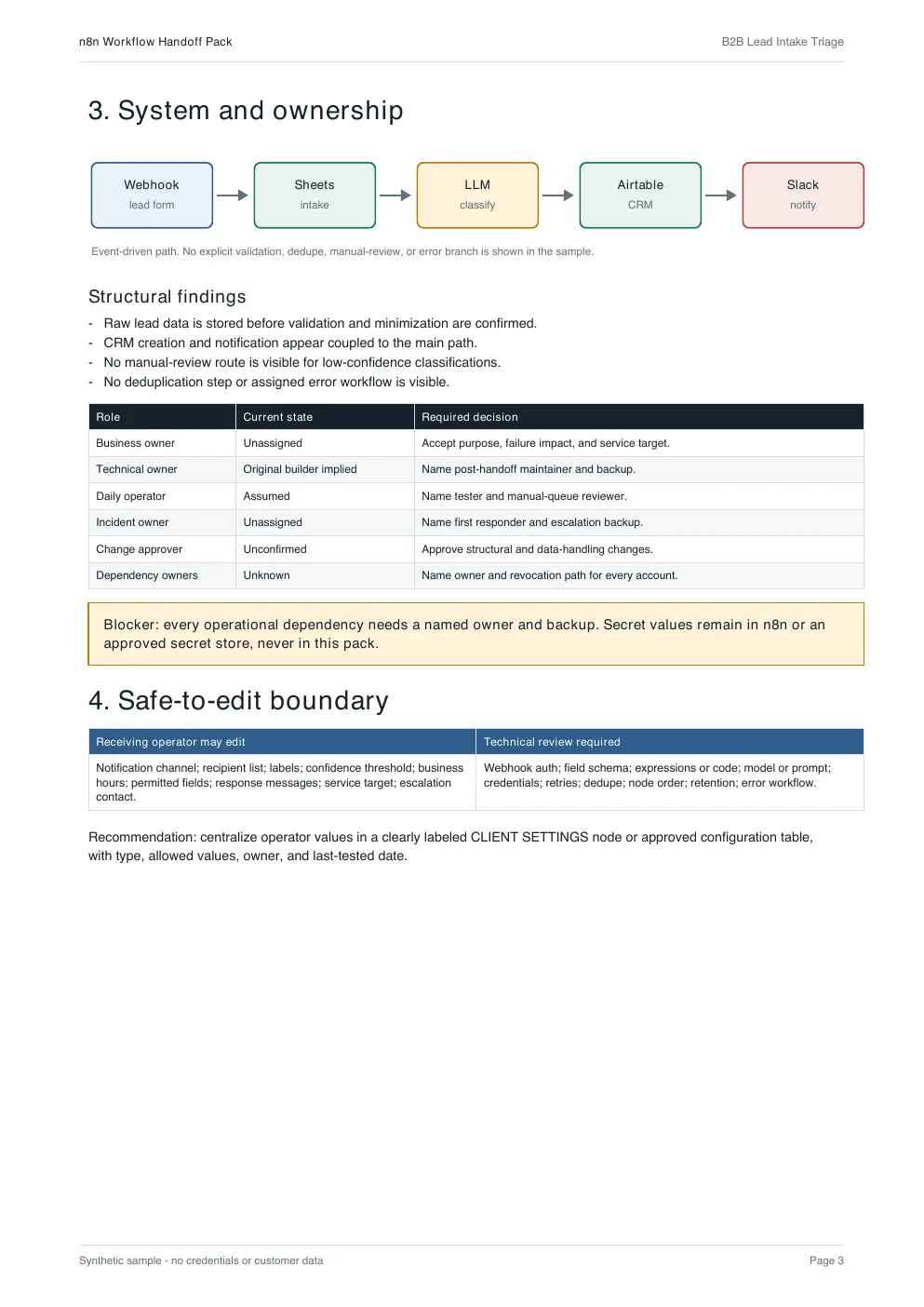
Workflow path, dependencies, account owners, and escalation roles.
Routine settings separated from structural changes requiring review.
Detection, automatic behavior, operator response, and escalation.
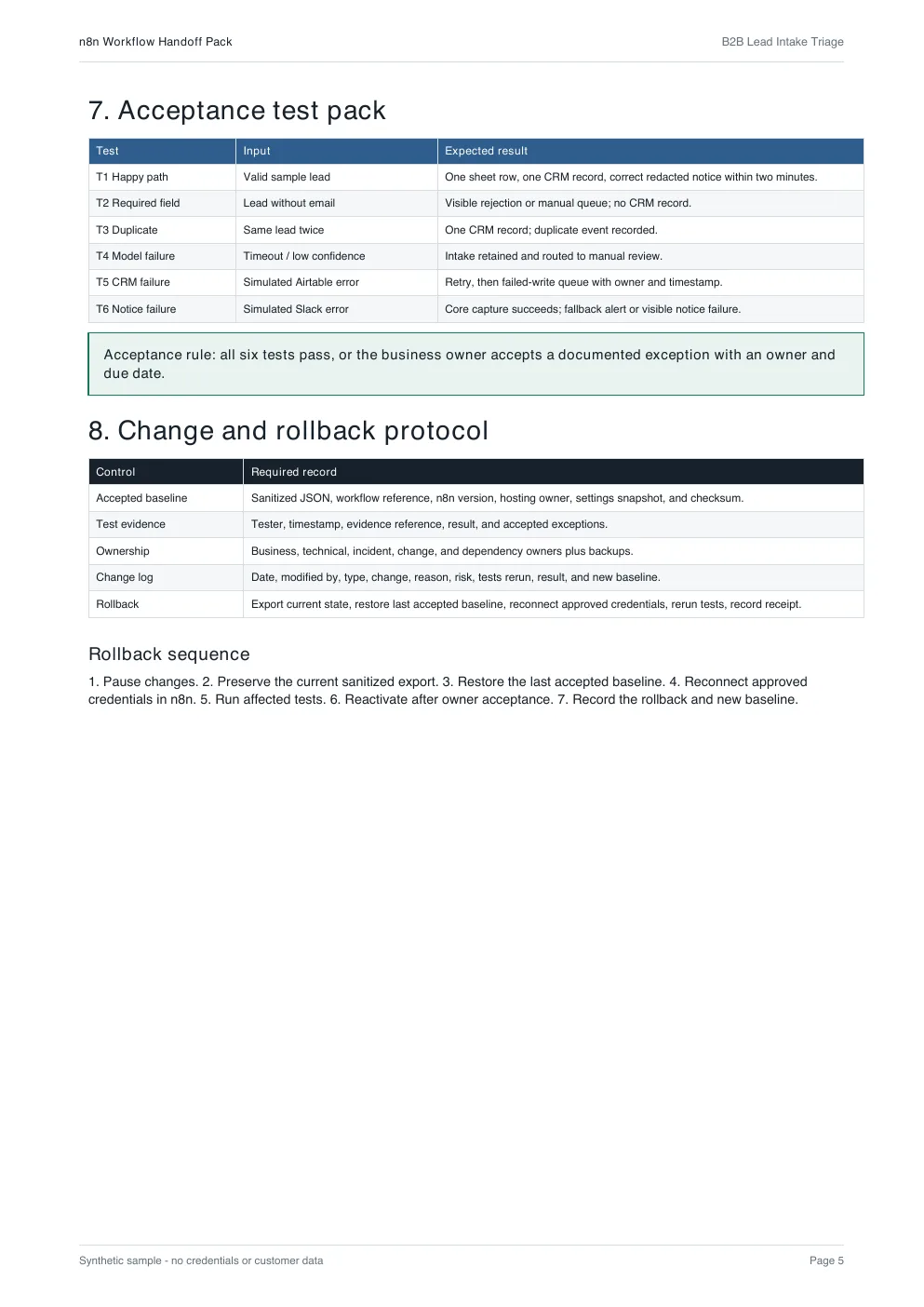
Happy path, invalid input, duplicate, dependency, and notification failures.
Version record, rollback checklist, receiving-owner acceptance, and sign-off.
How it works
No discovery call is required. Start with sanitized materials and the role of the intended new owner.
A sanitized workflow export or screenshots, tool list, current notes, and one redacted success or failure are enough to begin.
The workflow is reviewed for ownership, access, safe changes, failures, tests, data handling, baseline, and acceptance.
You receive the scored handoff pack within 48 hours after safe intake, plus an optional fixed-price completion scope if useful.
Clear scope
The audit is useful on its own. A completion sprint is separate, so the diagnosis is not tied to a larger build.
Handoff Readiness Audit
$500
One workflow. Fixed price. 48-hour delivery.
Optional completion sprint
$1,500-3,000
Quoted separately after the audit.
Safe intake
Materials can be sanitized before sharing. Credential names and account owners are useful; secret values are not.
FAQ
No. The audit can start from a sanitized export, screenshots, tool list, operating notes, and redacted execution evidence. Live access is outside the $500 read-only scope.
The audit identifies and prioritizes the missing transfer controls. Implementation is optional and quoted separately after the findings are clear.
You receive a prioritized P0, P1, and P2 completion plan, the blocked acceptance tests, and the exact evidence needed to declare the transfer complete later.
Yes. The output is designed to support a client or internal transfer. White-label presentation can be agreed before intake.
No. It also fits inherited workflows, contractor departures, internal ownership changes, and older automations that run but have no accepted operator or recovery standard.
Start asynchronously
The form prepares an email in your own mail app. Nothing is uploaded or stored by this page.
ben@handoffreadiness.com